
Why Nuclear
Meeting America's Energy Moment
America needs more energy, and it needs it now.
More energy is required to meet rising demand, grow U.S. manufacturing, and assure leadership in emerging industries such as artificial intelligence, advanced computing, electric vehicles, and advanced energy technologies. Electricity demand is increasing as the nation expands data centers, strengthens domestic production, and invests in innovation. At the same time, communities expect energy to remain affordable, reliable, and secure.
Nuclear energy is essential to meeting this moment.
Nuclear power offers safe, reliable, abundant energy that supports the nation’s energy, economic, and national security. America’s global leadership requires setting the standard for nuclear deployment, including innovation in advanced reactor technologies and fusion power. Expanding nuclear energy is not about choosing one energy source over another; it is about ensuring the energy system can meet future demand while delivering good jobs, lower energy costs, technological advances, and sustained global leadership.
Rising Demand Requires Reliable Power
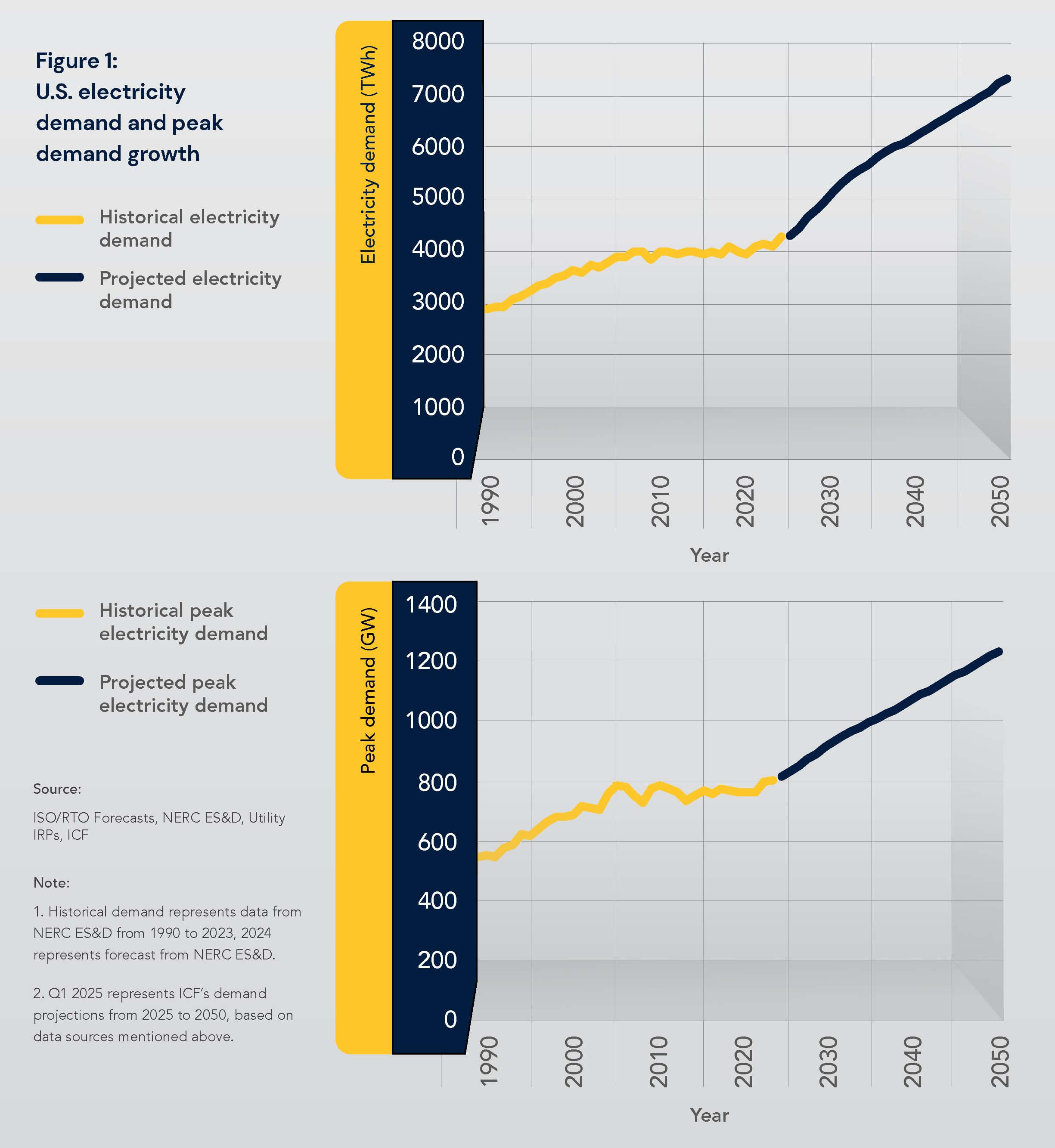
The United States needs significantly more electricity to support economic growth.
Estimates project:
-
A 25% increase in U.S. electricity demand by 20301
-
Up to a 78% increase by 20501
The largest drivers of this growth include:
-
Data centers supporting AI, high-performance computing, and cloud infrastructure
-
Advanced manufacturing and industrial facilities
-
Continued electrification of buildings and transportation
Historically, efficiency gains helped offset rising demand. Today, the rapid evolution of AI, advanced computing, manufacturing, and broader electrification, including transportation, means energy investments must occur now to unlock future efficiency gains.
Energy Is Economic and National Security
Around the world, countries face the same challenge: growing electricity demand driven by economic development, population growth, and technological advancement.
Energy security is directly tied to:
- Economic competitiveness
- Geopolitical stability
- National security
Electricity and energy are as essential to modern economies as currency. Nations that can reliably generate and supply energy will be better positioned to lead economically, technologically, and strategically.
“President Trump’s executive orders expand America’s Energy Dominance agenda… expanding our existing nuclear fleet and investing in advanced nuclear technologies ensures we have reliable energy to power our homes, fuel for manufacturing, and a stronger electric grid.” - Doug Burgum, U.S. Secretary of the Interior, May 23, 2025
Industry Beyond Electricity
Energy demand is not limited to electricity alone.
Global Competitiveness
International energy landscape presents realities:
Industries such as:
- Petrochemical production
- Fertilizer manufacturing
- Advanced materials
- Industrial processing
require high-temperature, reliable process heat that is difficult to provide with many energy sources. Nuclear energy, particularly advanced nuclear technologies, is uniquely suited to meet these needs while reducing emissions and strengthening domestic supply chains.
The international energy landscape presents two clear realities:
- Countries that meet growing energy demand will have stronger, more resilient economies.
- Countries that supply energy technologies to global markets will gain significant economic and strategic advantages.
Nuclear energy enables both. By advancing nuclear deployment, workforce development, and supply chains, the United States can: Strengthen domestic manufacturing; export high-value technologies and expertise; and, set global standards for safety and innovation.
Efficient, Scalable, & Adaptable
Nuclear energy plays a critical role alongside other energy sources in building a resilient energy system.
The Future Is Being Built Now
Communities are competing for nuclear development, for power generation and as an enabling technology for economic growth.
Key advantages include:
- Scalability
Power uprates at existing nuclear plants can add near-term capacity. Existing nuclear sites also offer infrastructure advantages for deploying new technologies. Multi-unit nuclear plants benefit from economies of scale, with generation costs up to 30% lower per MWh than single-unit facilities.2 - Low Land Use
Nuclear energy produces large amounts of power using relatively small land areas, allowing it to use existing sites and infrastructure and reduce transmission losses.2 - Responsiveness to Demand
AI data centers and advanced manufacturing require near-instant response to demand spikes, a capability nuclear energy provides. - Multiple Uses
When electricity demand is low, nuclear facilities can shift to producing heat for applications such as hydrogen production or industrial processes.
Regions that invest in: a skilled nuclear workforce, a nuclear-friendly regulatory and business environment, and strong supply chains will be best positioned to attract energy-intensive industries and participate in the growing global nuclear market.
Tennessee is already a leader.
- Tennessee has reliable power with 42% coming from TVA's nuclear fleet3
- state support with $150M+ investment; proven leadership from anchors ORNL, TVA, UT, UCOR, and Y-12 supporting federal national science, energy, environmental, and security missions
- an active full talent pipeline building the future nuclear workforce
- and, a historical innovative legacy as a primary site for the Manhattan Project
With continued investment, advocacy, and education, Tennessee will shape the next era of American energy leadership.
View the Tennessee Nuclear & Innovative Energy Day on the Hill one-pager for more on Tennessee’s nuclear energy priorities.
1 ICF, https://www.icf.com/insights/energy/electricity-demand-expected-to-grow and https://www.icf.com/insights/energy/demand-growth-challenges-opportunities-utilities?
2 Pathways to Commercial Lift-Off: Advanced Nuclear, Dept. of Energy, https://climateprogramportal.org/wp-content/uploads/2025/02/LIFTOFF_DOE_AdvNuclear-vX7.pdf
3 U.S. Energy Information Administration (EIA) - TN Energy Profile, 2024, https://www.eia.gov/electricity/state/tennessee/